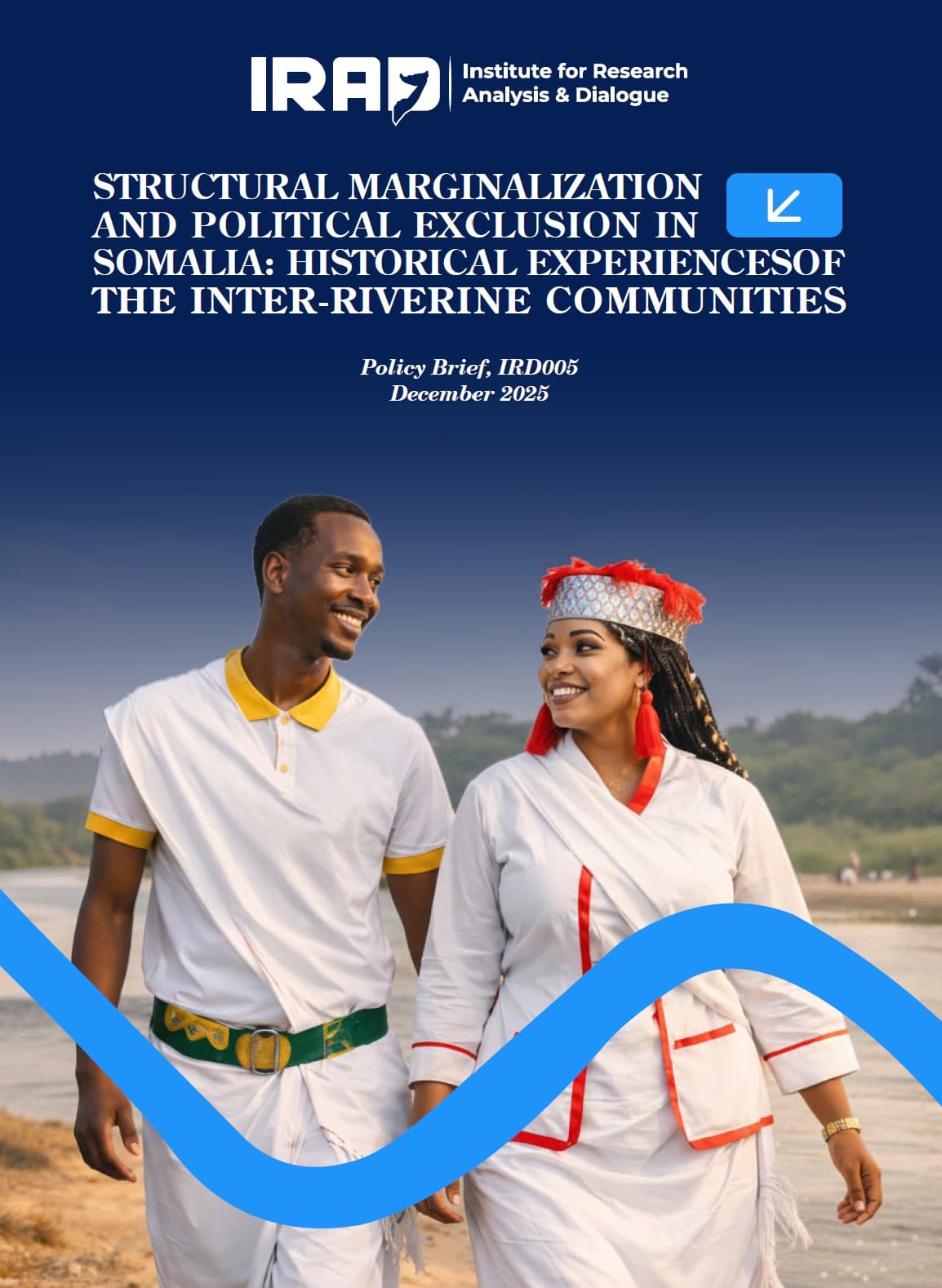
STRUCTURAL MARGINALIZATION AND POLITICAL EXCLUSION IN SOMALIA: HISTORICAL EXPERIENCES OF THE INTER-RIVERINE COMMUNITIES
Somalia’s national narrative has long rested on a cultivated myth of homogeneity—one language, one
religion, one culture—presented as the bedrock of unity. In reality, the country is deeply plural, shaped
by multiple languages, cultures, and historical experiences that predate the modern state. The
insistence on uniformity has not unified the nation but served as a political instrument, masking a
stratified system of power rooted in hierarchical clan relations. What is framed as shared identity has
instead normalized exclusion and preserved an unequal political order. Since independence, political
authority, military command, and access to public resources have been disproportionately monopolized
by two dominant clan families, the Hawiye and Daarood, shaping both state formation and patterns of
exclusion (Lewis, 2002; Menkhaus, 2014). Other major communities, most notably the Digil & Mirifle,
have remained persistently marginalized across successive political eras.
Occupying some of the most fertile regions in south-central Somalia, the Digil & Mirifle constitute the
backbone of the country’s agricultural economy. Their lands have historically supplied staple grains,
livestock, and export crops essential to national food security. Yet this economic centrality has not
translated into political representation or protection. Instead, Digil & Mirifle territories have
repeatedly been subjected to state repression, militia occupation, and extremist control, while their
communities have been excluded from meaningful participation in national governance and denied
adequate security provision.
DOWNLOAD STRUCTURAL MARGINALIZATION AND POLITICAL EXCLUSION IN SOMALIA REPORT